Washing & aftercare
Ceramic coating maintenance: washing, drying and aftercare
Maintain a ceramic-coated car by following its cure instructions, washing with compatible products and clean tools, and drying before water leaves deposits. Coatings still need cleaning. Match the method to the contamination and the installed product, and investigate changes in appearance before adding more protection.
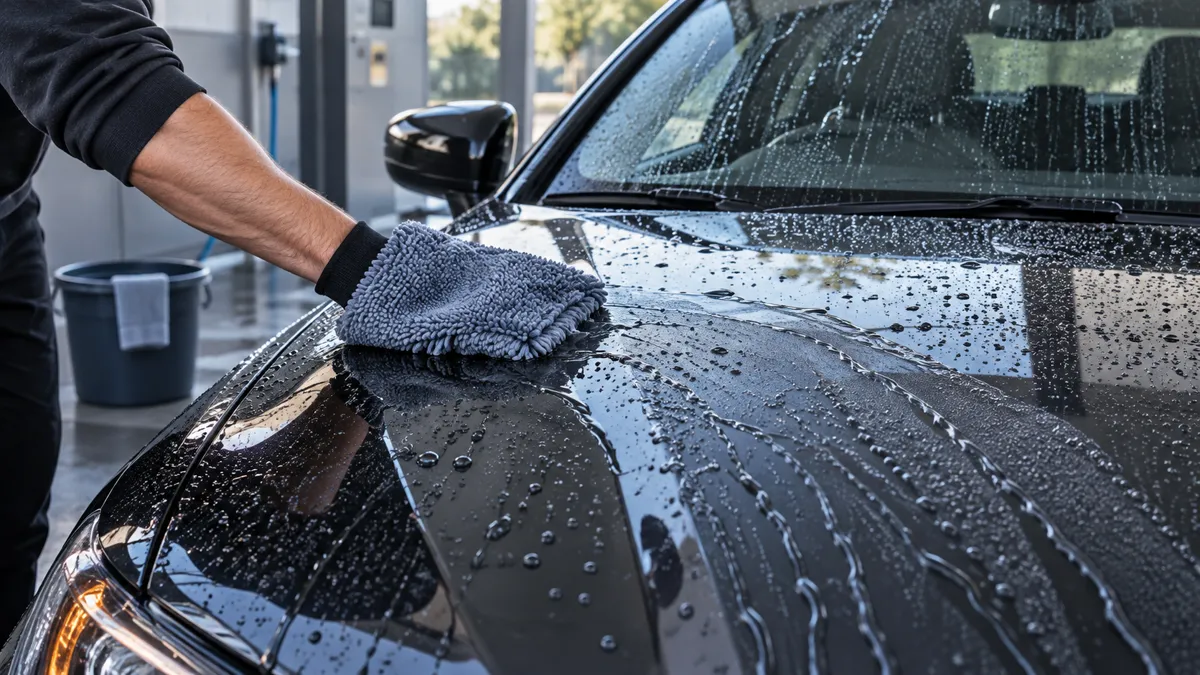
Wash safely
Use compatible products and clean tools; avoid dragging grit across the finish.
Dry & inspect
Remove standing water and check for residue, staining or contamination.
Treat the cause
Identify the problem before reaching for stronger chemicals or another layer.
In this guide 8 sections
Swipe the table to compare the options →
| Observation | First step | Avoid |
|---|---|---|
| Less beading after ordinary driving | Compatible wash, then inspect for contamination | Calling the coating dead from a single water test. |
| Mineral spots after water dries | Ask about the product-approved spot treatment | Assuming more shampoo or hard scrubbing will remove etched damage. |
| Roughness after washing | Identify the contamination and suitable chemical treatment | Automatically claying an otherwise working coating. |
| Uneven cured residue after installation | Contact the installer or follow product-specific remedy guidance | Applying another coating to hide it. |
| Peeling clear coat or lifting film | Have the affected surface assessed | Treating underlying damage as routine coating maintenance. |
Record what was applied before planning aftercare
Keep the invoice and handover sheet with the exact products used on paint, film, wheels, glass and trim. Those surfaces can have different cure limits, cleaners and warranty conditions. A brand name alone may not identify the formula.
Record the installation date, initial restrictions, registration details and who to contact about contamination during curing. Product-specific instructions take priority over a generic calendar.
- Exact product on each surface.
- Installation date and cure restrictions.
- First-wash and contamination instructions.
- Warranty registration, inspections and maintenance records.
Start with the problem, not another product
Aftercare decisions change with the symptom and the surface. A cure-period contamination event, mineral deposit, loss of beading, rough paint, lifting film and a planned recoat are different problems. Identify what changed before reaching for a topper, clay tool or polish.
Use the paths below as a small problem library. Product-specific instructions still govern cure windows, chemistry, warranty inspections and compatibility.
| What you notice | Start here | Do not assume |
|---|---|---|
| Contamination during the cure period | Use the installer or manufacturer handover instructions | A universal waiting period or aggressive spot treatment. |
| Mineral spots after water dries | Wash, inspect and check for a compatible spot treatment | Strong beading prevents deposits or proves the coating is healthy. |
| Reduced beading or new roughness | Separate road film, iron, tar and other bonded contamination | The coating has failed or clay is automatically required. |
| Uncertain topper or wash chemistry | Check the exact coating and product compatibility | Every “ceramic” maintenance product fits every coating. |
| Film edges lift or a film surface changes | Follow the film maker’s care path and contact the installer | A paint-polishing or coating remedy is suitable for film. |
| Correction or recoating is proposed | Identify the existing system and itemize preparation | A topper repairs failure or a new coating can cover an unknown surface. |
Before the first wash after ceramic coating
Get the coating name and written handover instructions from the installer, or retain the manufacturer’s application guide for a DIY installation. Confirm when the car can get wet, when washing is allowed and how to handle contamination during curing.
Those intervals vary by product and conditions. Avoid adopting a generic cure schedule from a different coating. Contact the installer if bird droppings or other contamination lands on the car during the restricted period.
How to wash a ceramic-coated car
Work on cool panels in suitable shade. Inspect the car and rinse away loose dirt where the method and location permit. Use a coating-compatible shampoo mixed at its labeled dilution, along with clean wash media.
Wash manageable sections, prevent cleaner from drying on the surface and keep dirty tools from carrying grit to another panel. Separate wheel-cleaning tools from paint tools. Rinse as directed and inspect for remaining contamination before drying.
- Check the installed product and its cure restrictions before washing.
- Prepare clean wash media, correctly diluted shampoo and separate wheel tools.
- On cool panels, remove loose grit before contact washing.
- Wash manageable areas without transferring grit or letting cleaner dry.
- Rinse as directed and inspect before drying.
- Dry with clean tools and light pressure; check mirrors and trim for trapped water.
Dry the paint before water leaves deposits
Use a clean, suitable microfiber drying towel with light pressure, or an appropriate blower used according to its instructions. Do not drag a towel across dirt missed during the wash.
Pay attention to water collecting around mirrors, trim and panel gaps. Air drying can leave mineral deposits, even on a strongly water-repellent surface. A compatible drying aid is optional; follow the coating’s care guidance.
What to do about water spots and reduced beading
Water repellency does not prevent minerals being left behind when water evaporates. Start with appropriate washing and inspection. If deposits remain, check for a coating-compatible water-spot treatment and follow its label, including any small-area test.
Loss of beading can reflect surface contamination rather than complete coating failure. A topper may change beading without establishing the condition of the coating below. Persistent marks or uneven appearance call for an assessment before polishing or recoating.
Build a maintenance routine around actual conditions
Inspect regularly and wash according to contamination, use and the product instructions. A car parked outside or driven through dirty conditions may need different care from one kept indoors. There is no single wash interval that fits every vehicle.
Keep the coating’s warranty and inspection requirements with your vehicle records. Use boosters only when appropriate for that coating; repeatedly layering unrelated products is not a substitute for cleaning.
Know when cleaning has become an assessment decision
Persistent mineral marks, roughness after suitable cleaning, lifting film, failed paint or defects that may require polishing are not solved by automatically adding a topper. Identify the surface and problem before choosing treatment.
If correction or recoating is being proposed, ask for the preparation, expected improvement and new protection as separate line items. The price index can provide advertised-market context, but it is not a quote for diagnosing your vehicle.
Professional installation
Know what goes into your quote.
Compare local installers, then ask about the exact product, preparation and covered surfaces.
Sources and review notes
This guide uses manufacturer instructions and, where relevant, our catalog of advertised prices. Manufacturer durability claims are not our own test results. Follow the instructions for your exact product.
- Gtechniq: washing a coated carManufacturer guidance on washing, drying and maintenance.
- Gtechniq: coating questionsManufacturer explanations of surface contamination, water spots and coating limitations.
- CARPRO: coating instruction manualsProduct-specific preparation, application and curing instructions.