How-to guide paint decontamination products
How to decontaminate car paint: a 3-step guide
Learn when car paint needs iron remover, tar remover or clay before coating. Follow a three-step process and avoid unnecessary abrasion on coated paint.
As an Amazon Associate we earn from qualifying purchases. Amazon links open in a new tab.
Choose a product 4 options
Compare paint decontamination products

GYEON
Iron Redefined
Chemical iron treatment
Check Amazon for current price
GYEON Iron addresses ferrous contamination after washing.
Product details & buying advice
Gyeon Iron Redefined Paint Cleaner and Fallout Remover Color-Change Formula
GYEON Iron addresses ferrous contamination after washing. It can reduce the amount of bonded material that would otherwise be handled mechanically.
Consider: Use only when the contamination and surface compatibility warrant it. It does not remove every rough deposit.
Product instructions from GYEON
CARPRO
TarX
500 mL with sprayer
Check Amazon for current price
CARPRO TarX provides a separate option for sticky tar deposits.
Product details & buying advice
CARPRO TarX Tar and Adhesive Remover 500 Milliliter with Sprayer
CARPRO TarX provides a separate option for sticky tar deposits. Treat the affected areas according to the product directions instead of scrubbing them with your wash mitt.
Consider: Check restrictions for trim, film, coating and other surfaces. Rinse and keep chemical steps separate.
Product instructions from CARPRO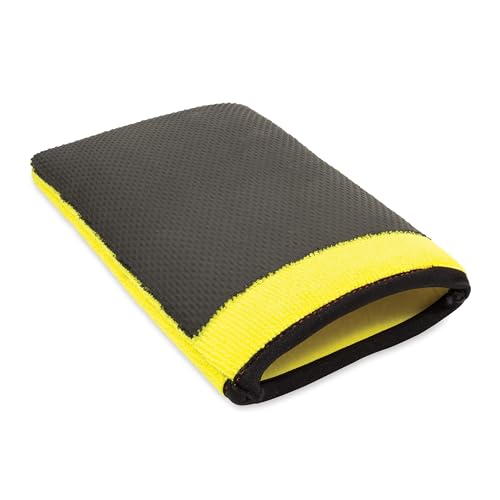
Griot's Garage
Fine Surface Prep Mitt
Fine mechanical decontamination mitt
Check Amazon for current price
A fine surface-prep mitt is an option for residual bonded contamination when mechanical treatment is appropriate.
Product details & buying advice
Griot's Garage Fine Surface Prep Mitt for Car Detailing, Clay Bar Alternative, Auto Cleaning Tool for Paint, Glass, Chrome, and Plastic, 10678
A fine surface-prep mitt is an option for residual bonded contamination when mechanical treatment is appropriate. Use the specified lubricant and a careful test area.
Consider: Mechanical decontamination can mar paint and affect an existing coating. Do not use it as an automatic finish to every wash.
Product instructions from Griot's Garage
CARPRO
Eraser
Polishing-oil and residue remover
Check Amazon for current price
CARPRO Eraser fits the final preparation stage for compatible coating systems after polishing residue has been removed.
Product details & buying advice
CARPRO Eraser Polish & Oil Remover - Ceramic Coating Prep, Complete Removal of Polishing Oils for Application of CQUARTZ Ceramic Coat, Anti-Static, Dust Free, No Silicone - 1 Liter (34oz) and Sprayer
CARPRO Eraser fits the final preparation stage for compatible coating systems after polishing residue has been removed. It serves a different job from iron or tar remover.
Consider: Panel prep is not a substitute for washing or bonded-contamination removal. Follow the coating maker’s approved preparation process.
Product instructions from CARPROPrices and availability may change. The price shown on Amazon at checkout applies.
Paint decontamination products compared
| Product | Best fit | Size or specification | Amazon price |
|---|---|---|---|
| GYEONIron Redefined | When ferrous fallout remains | Chemical iron treatment | See product |
| CARPROTarX | When tar remains | 500 mL with sprayer | See product |
| Griot's GarageFine Surface Prep Mitt | When bonded roughness still needs removal | Fine mechanical decontamination mitt | See product |
| CARPROEraser | Final prep where the coating permits it | Polishing-oil and residue remover | See product |
Swipe to compare specifications and prices →
Learning how to decontaminate car paint starts with identifying what remains after washing. Use chemical treatment for the contamination it is designed to remove, then assess whether mechanical decontamination is still necessary. Before ceramic coating, finish with the manufacturer’s preparation process; on a coated car, avoid automatically repeating the whole installation prep routine.
Product selection
Choosing paint decontamination products
The three steps are wash and inspect, treat the relevant bonded contamination, then reassess and prepare for your next job. Iron remover, tar remover and clay are conditional tools—not three chemicals you must use on every car. If polishing follows, complete it before the final coating preparation.
Compare the products aboveBefore you buy and use these products
- Distinguish preparation for a new coating from care of an existing one.
- Try the appropriate chemical treatment before deciding on mechanical work.
- Reassess after rinsing and plan protection after any justified polishing.
Step 1: wash, rinse and inspect
Start with a thorough wash using appropriate tools and shampoo. Keep wheel tools separate, rinse away loose debris and let the surface cool if needed. Inspect the clean finish under good light before choosing chemicals.
Decide what job comes next. Preparing uncoated paint for correction and coating is different from maintaining an intact coating. Do not use a strip-wash or full abrasion routine by default simply because the word decontamination appears in a guide.
Step 2: treat the contamination you actually have
Use a compatible iron remover for suspected ferrous deposits and a suitable tar remover for tar. Follow the individual label’s application, dwell and rinse requirements. Never mix the products, use them on hot panels or allow them to dry against the instructions.
Reinspect between steps. Color change is evidence of a product reaction, not a certificate that every deposit is gone. Water spots or etched marks may need a different diagnosis rather than another round of iron treatment.
Step 3: reassess, then prepare for polishing or coating
If bonded roughness remains and mechanical decontamination is appropriate, use a fine clay product or mitt with the required lubricant and light pressure. Test first and inspect for marring. Skip this step when the clean surface does not need it.
If you polish, do that before the final coating prep. Then remove residue and oils using the coating manufacturer’s specified process and let the surface reach the required dry condition. Coating over unresolved contamination or preparation residue compromises the installation process.
What changes on an already-coated car?
Follow the coating maker’s maintenance directions and start with the least invasive suitable treatment. Chemical compatibility, dwell time and the condition of the finish matter. Clay and polishing can affect protection and should not become routine maintenance by habit.
A decline in water beading is a reason to inspect and clean, not proof that the entire coating must be stripped. If cleaning does not resolve the issue, consult the coating instructions or installer before choosing a correction or reapplication process.
Questions about paint decontamination products
Do I have to clay before ceramic coating?
Only if remaining contamination and the preparation process warrant it. Chemical decontamination and inspection may show that clay is unnecessary. Clay can mar paint, so use it deliberately.
Does panel prep replace decontamination?
No. Panel-preparation products address residue such as polishing oils. They are not substitutes for washing, iron removal, tar treatment or mechanical removal when those are needed.

